We live once, but we don’t have to die once.
We live once, but we don’t have to die once.
ये शाम अपने में मदमस्त है, न भुत न भविष्य है|
ये शाम अपने में मदमस्त है|
इस शाम की हावो में हवा में बहती मेरी रूह है|
मेरी साँस खोती मेरी अंदर, ये वो शाम जब मेरा मन स्थिर है|
आँखों में नमी, चेहरे पे झील सा शांत एहसास है|
आज की शाम मेरी जाम है|
ये शाम अपने में मदमस्त है, न भुत न भविष्य है|
अमित
My first publication with Vishu ( theoretical ecology evolutionary lab) is out:
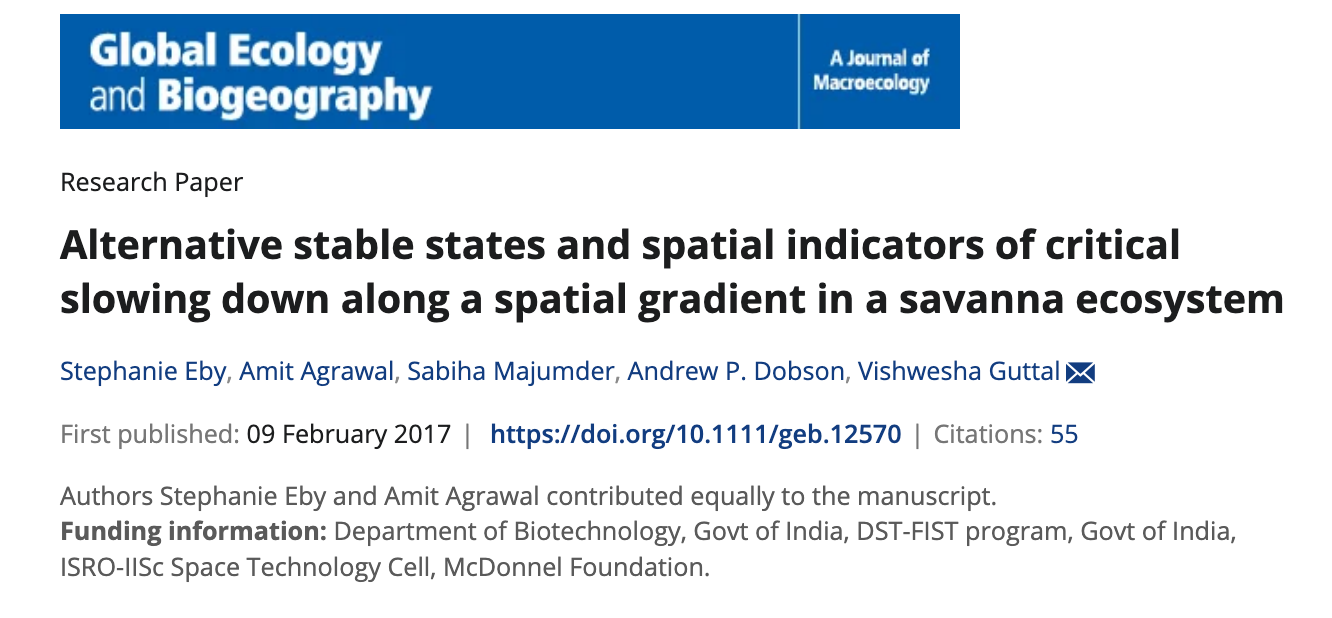
I developed an interest in aging research back in high school when my teacher explained the concept of oxidative reactions and how they contribute to aging in humans. This sparked my journey into understanding the aging, leading me to shift my focus from mathematics and physics to biology. Although I didn’t have the opportunity to work on aging during my bachelor’s studies, I delved into aging literature. To train myself as an experimentalist, I undertook a project on enhancing drug delivery through nano-encapsulation. Additionally, my bachelor thesis explored the theory of early warning signals for critical transitions. I loved working on the theory of critical transition and continued working after my engineering degree as a project assistant to finish the project.
Currently, I am engaged in a project on translational regulation of metabolic shifts in yeast. While I also find talks and seminars on regenerative medicine, evolution, and ecology super intriguing. Despite all this, the desire to work on aging persists, even though I have never been directly involved in aging research.
Whenever I contemplate turning away from the field of aging research, I cannot help but feel that I am distancing myself from unraveling the mystery of nature that dictates our inevitable mortality. The prospect of people, including my loved ones, succumbing to the effects of aging fills me with a sense of despair. Yet, this concern only serves to further fuel my relentless curiosity and unwavering resolve to unravel the secrets of this natural phenomenon, for aging remains the most captivating and deeply personal subject for me.
After doing a lot of theory on early warning signals for abrupt transitions in a bistable savanna ecosystem at Theoretical Ecology & Evolution laboratory, I have got an opportunity to start working on my interest as a post-baccalaureate researcher. I have recently joined Sunil Laxman’s laboratory at inStem, NCBS, Bangalore to work on aging. My motivation to join this laboratory is to work on “how manipulation of a particular amino acid in the diet of yeast can affect the protein homeostasis and aging of this organism.”
Currently, Sunil is helping me in refining the question as well as equipping myself with some new wet laboratory skills. I will update you soon about my work.
Cheers
Amit
Following is the video lecture link.
Selective excerpt from the above video.
Prof. P. Balaram-“What are Indian universities’ administrators concerned with? Indian universities’ administrators concerned with handling many local political situations many general political situations, there is no vice chancellor in India who is allowed anytime to do anything academic or worry about any academic things their universities. And therefore, having been the director of Indian Institute of Science for nine years, I can say that the Indian Institute of Science may be the last bastion, where even if you are the director of Indian Institute of Science, you can worry about something academic at least for twenty percent of your time but not more than that…in the night at least you can worry about academic matters…
It is not enough to have petty understanding of local politics, as being the driving force in determining the way this country will go.”z
Here, I am giving brief introduction of the association of Gerontology (AGI), and in next few paras I have mentioned about the interesting events of this conference, some exciting news that I came to know. Prof. M.S. Kanungo founded the Association of Gerontology, India (AGI) in 1981, for the advancement of gerontology in India. This society’s work concerns all aspects of elderly population i.e., bio-gerontology, medical-gerontology and social-gerontology. Every two years AGI organises a meeting. This year it was at the Centre for Development Studies (CDS), Thiruvananthapuram, Kerala. Speakers came from BHU, AIIMS, JNU and many other research institutions.
Biogerontology session included talks on the effect of environmental and genetic factors on aging and age related disorders such as ameliorating effects of dietary restriction on aging, effects of natural compound and exercise on boosting the memory of diabetic and old mice. There was also one talk about reversing age related memory loss. Medical session included talks on ‘effect of aging on neuronal and glial population and on human pancreas’, use of serum sirtuin as frailty marker, and the tendency to fall in elderly people. Social session included talks on elderly abuse, elderly population in workforce, loneliness in elderly. There was many other interesting talks that I have not mentioned here.
There were some interesting informal discussions on making healthspan/lifespan ratio as possible as equal to one and AGI’s role in policy making for elderly population. On the second day of the conference, Minister of Social Welfare and Panchayats, Kerala, Dr. MK Muneer released Kerala Aging Survey and also discussed the Kerala Government’s motives to design policies to help growing elderly population.
I came across a great news for aging researchers during the conference: Government of India is going to establish two institutes on aging research: National Institute on Aging (NIA); one in Chennai, possibly within 3-4 years and another one in New Delhi maybe within a decade.
The next meet of AGI is going to be organized by Dr. A.B. Dey at AIIMS, New Delhi in September, 2016. I hope to present my work on the mechanisms of aging at the next meet.
Till now aging has killed us, now it’s our time to kill the aging.
 mechanism of aging